
E-mail:
sale08@lzxkjx.comCall Us:
+86 15390744145
The quartz sand magnetic separation process is a physical beneficiation method that utilizes the differences in mineral magnetism to separate materials. It is specifically employed to remove magnetic impurity minerals, such as iron and titanium-bearing minerals, from quartz sand. The following is a detailed introduction to this process.
I. Basic Principles
Quartz itself is a non-magnetic mineral and cannot be magnetized in a magnetic field. However, iron-bearing impurity minerals (such as hematite, limonite, magnetite, goethite, ilmenite, etc.) and titanium-bearing minerals (such as ilmenite, rutile, etc.) present in quartz sand exhibit varying degrees of magnetism. The magnetic separation process leverages this difference in magnetic properties, using a magnetic field to separate the magnetic impurities from the non-magnetic quartz.
II. Classification of Magnetic Separation Equipment
By Operating Mode:
Dry Magnetic Separator: Suitable for water-scarce areas, produces no wastewater. It typically uses an enclosed or wrap-around magnetic system, preventing material agglomeration.
Wet Magnetic Separator: Suitable for quartz sand with high moisture content. The iron removal effect is generally superior to dry separation.
By Magnetic Field Intensity:
Low-Intensity Magnetic Separator (0.5 - 1.0 T): Removes strongly magnetic minerals like magnetite.
Medium-Intensity Magnetic Separator (1.5 - 2.0 T): Removes weakly magnetic minerals like hematite and limonite.
High-Intensity Magnetic Separator (3.0 - 5.0 T): Removes very weakly magnetic minerals like ilmenite and monazite.
High-Gradient Magnetic Separator (HGMS): Possesses a stronger capability to capture weakly magnetic impurities present in fine-grained minerals.
III. Multi-Stage Magnetic Separation Process Flow
The multi-stage magnetic separation process follows the principle of "low intensity first, then high intensity, multi-stage series connection, and cyclic optimization."
Pre-treatment Stage:
Crushing: Crush the raw ore to a fine particle size (ensuring >80% passing -0.1mm).
Grinding: Use a ball mill for wet grinding to achieve >50% passing -0.074mm. This ensures the liberation (monomer dissociation) of magnetic impurities from quartz minerals.
Primary Magnetic Separation (Low-Intensity - Removal of Strong Magnetic Impurities):
Equipment: Low-intensity magnetic separator (e.g., Permanent Drum Magnetic Separator).
Parameters: Magnetic field intensity 0.5-1.0 T, pulp density approx. 25%.
Purpose: Remove strongly magnetic impurities like magnetite to prevent clogging of subsequent equipment.
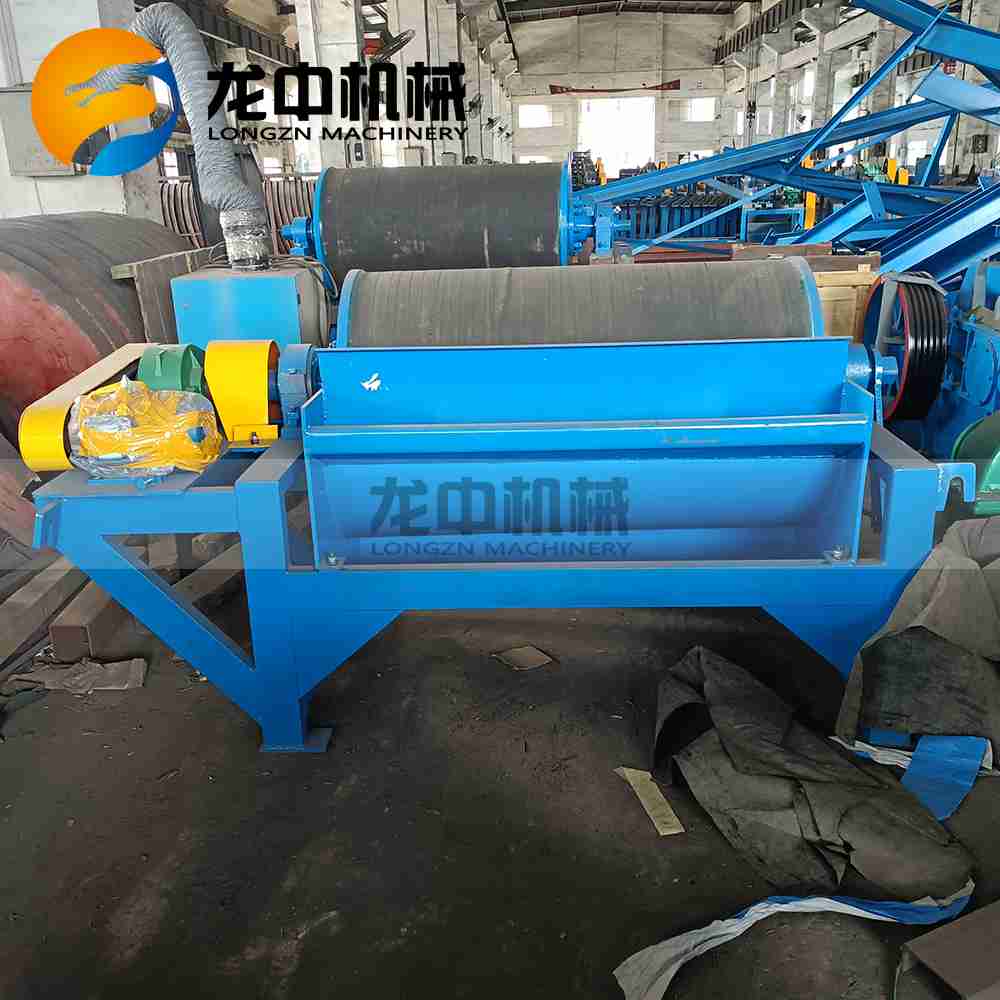
Secondary Magnetic Separation (Medium-Intensity - Removal of Weak Magnetic Impurities):
Equipment: Medium-intensity magnetic separator (e.g., Vertical Ring Pulsating High Gradient Magnetic Separator).
Parameters: Magnetic field intensity 1.5-2.0 T, background field intensity 1.2-1.5 T.
Purpose: Remove weakly magnetic impurities such as hematite and limonite.
Tertiary Magnetic Separation (High-Intensity - Removal of Very Weak Magnetic Impurities):
Equipment: High-intensity magnetic separator (e.g., Superconducting High Gradient Magnetic Separator).
Parameters: Magnetic field intensity 3.0-5.0 T.
Purpose: Remove very weakly magnetic impurities like ilmenite and monazite, as well as composite particles (locked particles).
Post-treatment:
Dewatering: Thicken the concentrate to 40%-50% solids, followed by filtration to achieve a moisture content of ≤10%.
Drying: Use a rotary dryer or tower dryer, controlling the temperature between 100-150°C.
IV. Key Factors Influencing Magnetic Separation Efficiency
Magnetic Field Intensity: The most critical factor. The appropriate intensity must be selected based on the magnetic susceptibility of the impurity minerals.
Feed Rate: Affects both processing capacity and separation efficiency.
Rinse Water Volume: Influences the effectiveness of washing away entrained non-magnetics from the magnetic product.
Number of Separation Stages: Generally, more stages lead to better iron removal efficiency.
Quartz Sand Particle Size: Finer particle sizes typically result in better iron removal efficiency, provided minerals are liberated.
V. Effectiveness and Limitations
Effectiveness: Wet high-intensity magnetic separators can produce high-quality quartz sand concentrate with an Fe₂O₃ content as low as 0.036%.
Limitations:
Can only remove magnetic mineral impurities. Its effectiveness in removing non-magnetic impurities like aluminum, potassium, and sodium-bearing minerals is limited.
For substantial amounts of weakly magnetic and non-magnetic mineral impurities, magnetic separation alone cannot achieve effective purification.
Often used as part of a combined purification process.
VI. Application Recommendations
For quartz sand primarily containing weakly magnetic impurity minerals, use a wet high-intensity magnetic separator (≥10,000 Oersteds).
For quartz sand primarily containing strongly magnetic minerals like magnetite, use a low-intensity or medium-intensity magnetic separator.
For quartz sand requiring high purity (e.g., photovoltaic grade, semiconductor grade), magnetic separation must be combined with other processes such as flotation or acid leaching.
Conduct regular quality testing (e.g., ICP-MS analysis for Fe, Al, Ti content) to monitor performance and optimize magnetic separation parameters.
As a critical step in quartz sand purification, the magnetic separation process plays an irreplaceable role in high-end manufacturing sectors such as glass, photovoltaics, and semiconductors. By rationally selecting equipment and optimizing process parameters, the purity and quality of quartz sand can be significantly enhanced.