
E-mail:
sale08@lzxkjx.comCall Us:
+86 15390744145
China is rich in mineral resources with massive annual extraction volumes, but the resulting issue of tailings is becoming increasingly prominent. According to statistics, China's tailings reserves have reached several billion tons, causing not only resource waste but also severe environmental pollution. However, tailings still contain a considerable amount of valuable components. Based on average grade estimates, China's tailings hold hundreds of millions of tons of recoverable minerals.
In this context, tailings reprocessing technology has become a key breakthrough for the green development of the mining industry.
01 Tailings: The Overlooked "Urban Mine"
After ore undergoes beneficiation to extract concentrate, the remaining part is tailings. For a long time, these tailings have been treated as waste and stockpiled in tailings ponds. However, with the increasing depletion of high-grade ore resources and stricter environmental requirements, the resource utilization of tailings has become particularly urgent.
Tailings contain a significant amount of valuable components that were not fully recovered, especially some weakly magnetic minerals. Taking tailings from a certain location as an example, their iron grade remains considerable. Recovering them through appropriate processes can substantially reduce resource waste. Magnetic separation is one of the core technologies in tailings reprocessing. It is simple, easy to implement, and pollution-free, making it particularly suitable for recovering magnetic minerals from tailings.
02 Vertical Ring Magnetic Separator: The "Workhorse" of High-Gradient Magnetic Separation
In tailings reprocessing processes, the Vertical Ring High-Gradient Magnetic Separator (VPHGMS) plays a crucial role. This equipment generates a high-gradient magnetic field, effectively recovering weakly magnetic minerals from tailings.
Patented technologies show that modern vertical ring magnetic separators have achieved intelligent control. They use PLC controllers to precisely adjust parameters such as magnetic field intensity and ring rotation speed, ensuring optimal separation performance.
Research indicates that using a vertical ring pulsating high-gradient magnetic separator for two stages of roughing to discard waste from specularite ore can discard waste rock with a yield of 22.33%, obtaining a pre-concentration coarse concentrate with an iron grade of 42.99% and an iron recovery rate of 96.03%.
In the tailings reprocessing flow sheet, the vertical ring magnetic separator is typically positioned after fine grinding to separate valuable minerals that have been liberated. This equipment generates a high magnetic field intensity, reaching up to 12,000 Gauss or more, enabling the effective recovery of fine-grained valuable components.
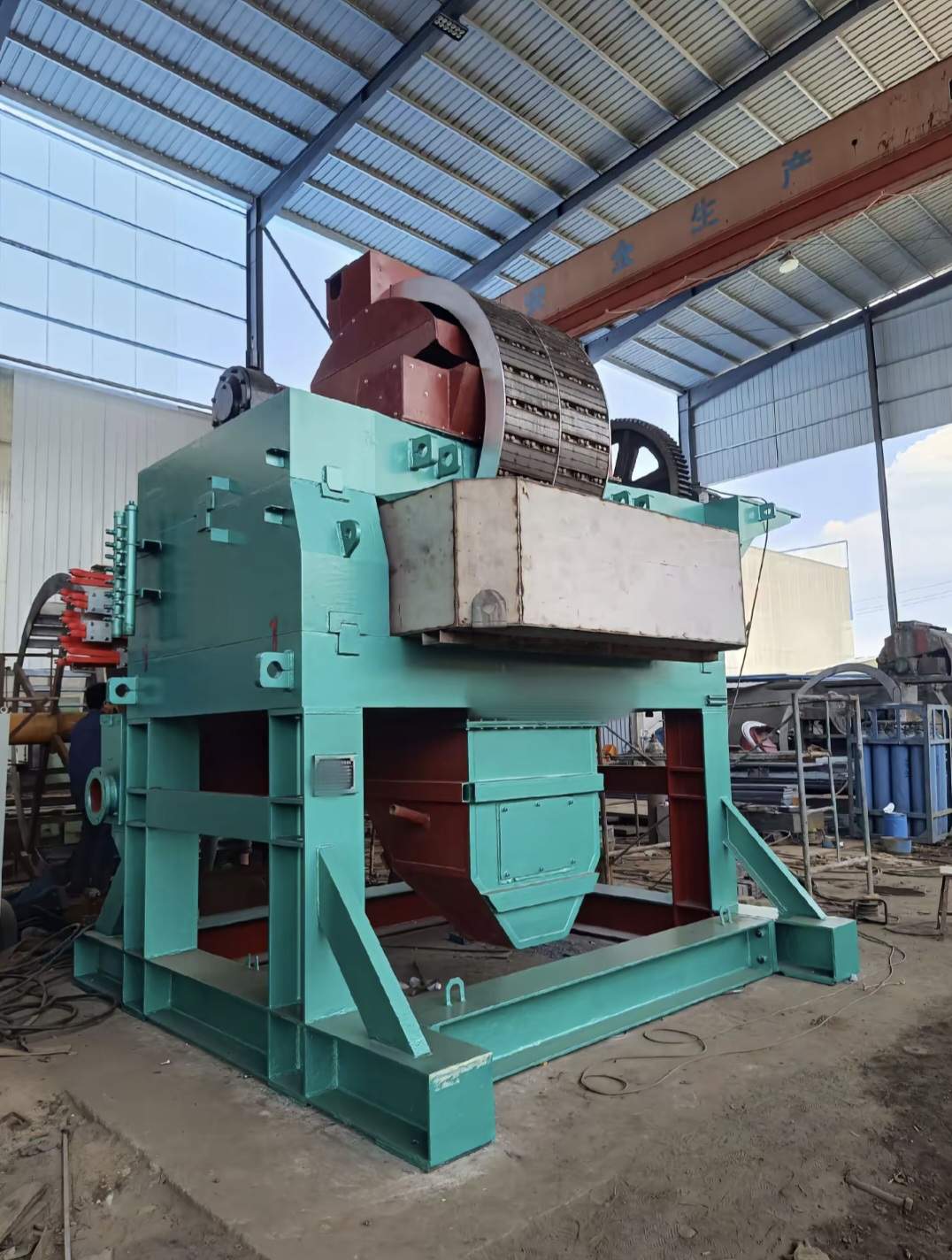
03 Drum Magnetic Separator: The "All-Rounder" for Coarse Particle Recovery
The drum magnetic separator is a common magnetic separation device in mines and is also widely used in tailings recovery. It features a simple structure, stable operation, and easy maintenance, making it particularly suitable for processing coarse-grained materials.
Taking the recovery from a certain iron ore tailings as an example, using a drum magnetic separator for roughing can quickly recover strongly magnetic minerals from the tailings, creating favorable conditions for subsequent cleaning. This equipment uses high-quality ferrite or rare earth magnetic steel composite magnetic systems, offering high magnetic field intensity and good separation efficiency.
Given the complex characteristics of tailings, new types of drum magnetic separators are equipped with intelligent scraper devices that can promptly remove magnetic agglomerates accumulated on the drum surface, ensuring continuous and stable operation. This innovative design significantly enhances the equipment's automation level and separation efficiency.
In the tailings reprocessing flow sheet, drum magnetic separators can be used for scavenging operations or as cleaning equipment. Their flexible configuration options meet the personalized needs of different mines.
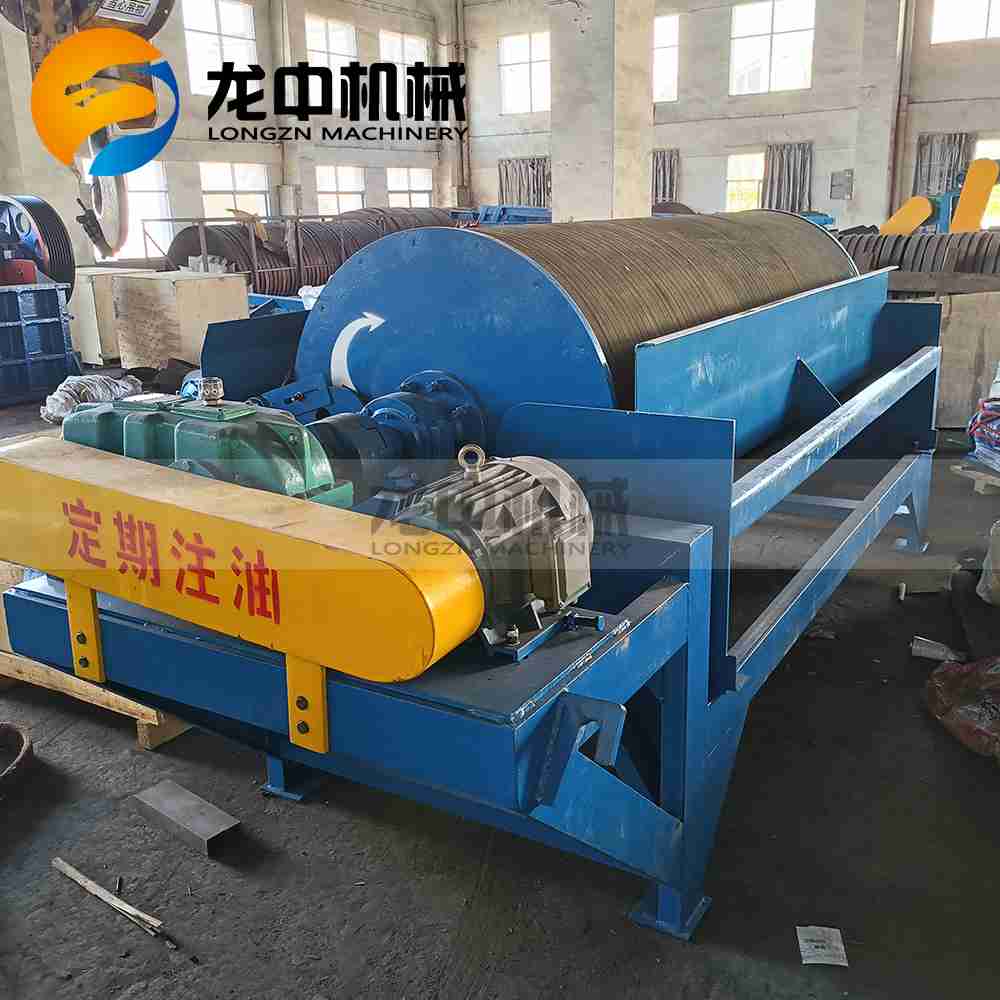
04 Flat Magnetic Separator: The "Special Forces" for Weakly Magnetic Mineral Recovery
For weakly magnetic minerals in tailings, the flat magnetic separator demonstrates unique advantages. This equipment effectively arranges thousands of strong permanent magnets, achieving a magnetic field intensity of over 14,000 GS across the entire flat plate surface, with a magnetic gradient distributed throughout the separation zone.
The flat magnetic separator employs a belt-type separation structure. Material undergoes multiple magnetic stirring actions as the belt moves, while gangue is removed under the flushing action of water, achieving efficient separation. Particularly noteworthy is the equipment's low motor power consumption, saving over 30% energy compared to conventional magnetic separators, resulting in significant energy savings.
In practical applications, the flat magnetic separator exhibits outstanding recovery effectiveness for weakly magnetic minerals such as manganese ore, hematite, limonite, and specularite. It can also be used for high-purity iron removal from non-metallic minerals, effectively reducing the iron content in potassium feldspar, fluorite, and quartz sand.
From a process configuration perspective, the flat magnetic separator can be used alone or combined with vertical ring and drum magnetic separators to form a complete "roughing + scavenging + cleaning" circuit, maximizing the recovery rate of valuable components.
05 Design of Tailings Reprocessing Process Flow
A complete tailings reprocessing process typically includes three main stages: scavenging, grinding, and magnetic separation.
Scavenging Stage: A scavenger is used to recover the portion of tailings that still contains a significant quantity of target elements. The scavenger consists of a main unit, ore discharge device, collection tank, chute, and frame. As the slurry passes through, magnetic minerals are adsorbed onto the magnetic discs, while the remaining part flows out with the slurry.
Grinding Stage: The coarse concentrate recovered by scavenging needs to be finely ground in a ball mill to achieve full liberation of valuable minerals from the gangue, preparing the material for subsequent magnetic separation. This step is crucial, directly impacting the final concentrate's grade and recovery rate.
Magnetic Separation Stage: Based on differences in ore properties, rationally combine vertical ring magnetic separators, drum magnetic separators, and flat magnetic separators. The general principles are: use drum magnetic separators for strongly magnetic minerals, and flat or vertical ring magnetic separators for weakly magnetic minerals; use drum magnetic separators for coarse particles, and vertical ring magnetic separators for fine particles.
Data shows that with a reasonable magnetic separation process, iron concentrate with a grade of over 60% can be obtained from tailings, with a recovery rate exceeding 85%. The concentration ratio can be controlled at around 1.85, resulting in significant economic benefits.
06 Comprehensive Benefits of Magnetic Separation Recovery
Recovering minerals from tailings using magnetic separation yields not only significant economic benefits but also considerable environmental advantages.
From an economic perspective: Tailings reprocessing can substantially improve mineral resource utilization, increase concentrate production, and reduce production costs. For example, at a certain tailings recovery plant, the magnetic separation process recovers tens of thousands of tons of iron concentrate annually, generating additional output value worth tens of millions of yuan. Non-metallic components in the tailings can also be used in construction materials, cement production, and other fields, achieving cascading resource utilization.
From an environmental perspective: Tailings reprocessing reduces land occupation by tailings and lowers the risk of environmental pollution. Toxic chemicals in tailings can contaminate water resources, and prolonged exposure to air can lead to weathering and the release of harmful gases. Through recovery and utilization, these environmental hazards can be significantly reduced. Some advanced mines have already achieved zero tailings discharge, completely "squeezing dry" the value from tailings.
07 Future Development Trends
As mineral resources become increasingly depleted, complex, and fine-grained, and environmental requirements continue to rise, tailings reprocessing technology will keep evolving.
Equipment Upscaling is an inevitable trend. Magnetic separators with larger processing capacities can reduce the number of units required, lowering investment and operational costs. Currently, the processing capacity of a single vertical ring magnetic separator can reach several hundred tons per hour.
Intelligent Control is the development direction. By monitoring parameters such as raw ore grade, slurry concentration, and magnetic field intensity online, the equipment's operating status can be automatically adjusted to achieve optimal separation results. Some companies have begun exploring digital twin technology to simulate and optimize the magnetic separation process in a virtual environment.
Process Integration is a key technological pathway. Organically combining magnetic separation with other methods like gravity separation and flotation enables the comprehensive recovery of multiple valuable components. Patented technologies indicate that combined "magnetic separation + flotation" processes can recover resources such as iron, copper, phosphorus, and precious metals from tailings.
High-Value Products is the ultimate goal. The value chain of tailings resource utilization is continuously extending, from simply recovering iron concentrate to preparing high-value-added materials like garnet-based adsorbents and polymer composites.